Agilink, a spin-off of Chinese robotics giant AgiBot, asked Fu Xianghong, a master of traditional Suzhou embroidery, to train its OmniHand 3 Ultra. The synthetic hand has learned to split silk strands, thread a needle, stretch fabric across a frame, and stitch, following a craft with more than 2,500 years of history.
A key step in Suzhou embroidery is dividing a main silk thread into its individual strands (16, according to the video below). To manage it, one finger teases the strands apart while the others hold the tension. The fingertips then have to stay in contact and let the thread rotate as it’s gently twisted. Threading and stitching add demands on positioning, force, and coordination.
Hand Over Hand
Agilink hasn’t said exactly which model appears in the video, but it looks identical to the OmniHand 3 Ultra-M. That version is roughly the size of a human hand and weighs 630 g (1.4 lb). It uses a direct-drive design, meaning no tendons or intermediate transmissions sit between motor and joint. It can hold 3 kg (6.6 lb) stably, lift up to 8 kg (17.6 lb), open and close in about 0.3 seconds, and repeat positions to within about 0.2 mm (0.008 in).
The robohand’s touch relies on vision-based sensors in each fingertip, which watch the contact surface for tiny changes, a bit like a camera peering at the inside of a soft pad. According to the company, the fingertips measure force in three dimensions and detect deformations of 0.08 mm (0.003 in). That helps the hand tell a slipping object from one it’s merely brushing. The palm adds a 300-point contact sensor.
Agilink – YouTube
The embroidery stunt points at a real bottleneck for humanoid robots. Without fine control of force, a machine can see and move but can’t act without breaking something or hurting someone. Developing mechanized hands capable of such dexterity could be a key driver in the adoption of humanoids in domestic settings, though likely won’t be needed for most factory jobs.
Progress in this space is rapid. LinkerBot’s Linker Hand L30 Pro, for instance, mimics human anatomy with five tendon-driven fingers, as ours do. It aims for speed and repeatability, meaning the same motion done consistently, in tasks such as driving screws or picking up thin sheets. But copying human anatomy makes the hands heavier, and LinkerBot concedes that fingertip force is modest.
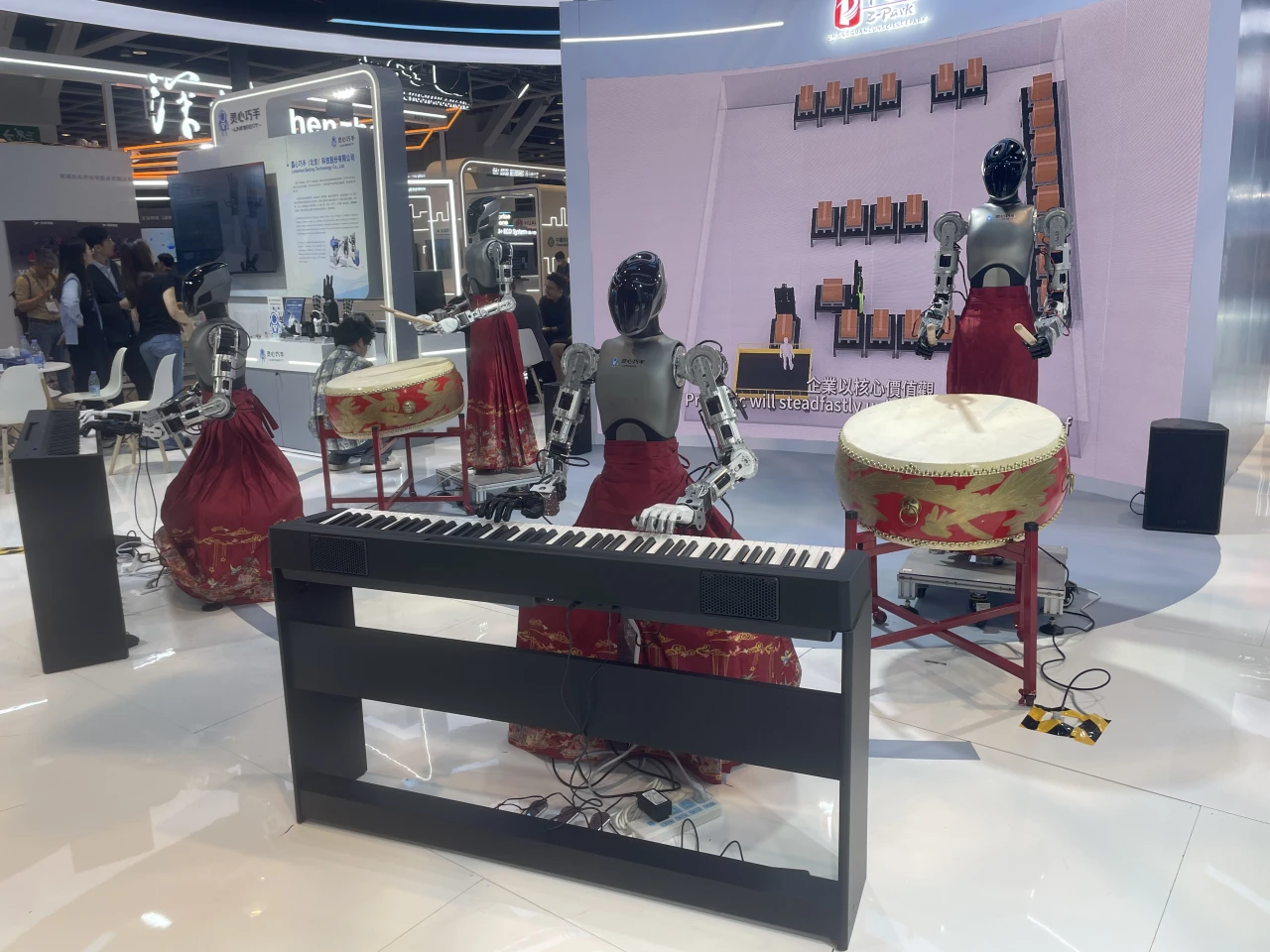
Bronwyn Thompson/New Atlas
That said, LinkerBot hands mounted to humanoid robots from a company called Humanoid genuinely impressed us during a recent visit to InnoEx in Hong Kong, where they tickled the ivories and bashed out some beats in a four-piece robo-band.
Boston Dynamics went another way with the newly unveiled hand for its Atlas robot, which has only four digits. Chief technology officer Zachary Jackowski had his team members bind their pinky and ring fingers for a day and report back to see how much they’d miss them. The verdict was that the pinky wasn’t needed, so it was dropped from the design. Each extra finger, the company argues, adds cost and another component that can fail or break. Its target is rugged factory work with tools like drills and welders.
New Hands for Atlas | Boston Dynamics
Aristotle called the hand the “tool of tools,” and Boston Dynamics has taken the phrase to heart. Its argument is that the general-purpose robot hand of the future will win by handling tools reliably, not by being dazzlingly complex. Getting there, though, means squeezing compact mechanics, touch sensing, control software, and fast computing into a single package.
A robot that handles silk like an artisan is impressive, but one that can run a drill on a factory line or help care for an elderly person without hurting them could change humanity forever.
Source: Agilink via PRNewswire